

Posted by Michele Priest on Mar 4th 2026
Reverse Osmosis vs Carbon Filters: Which Is Better for Drinking Water?
For most households using treated municipal water, a certified carbon filter, especially a NSF certified solid carbon block filter, often provides the best balance of contaminant reduction, taste improvement, cost, and convenience. Reverse osmosis (RO) systems remove a wide range of dissolved solids, but they also waste water, remove beneficial minerals, and require more maintenance than other carbon filters. The most important factor isn’t the type of system; it’s what contaminants the system is certified to reduce.
|
Quick Answer: Reverse osmosis and carbon filters both improve drinking water, but they work in different ways. Reverse osmosis uses a membrane to remove a wide range of dissolved contaminants, while activated carbon focuses on reducing chlorine, chemicals, and compounds that affect taste and odor. |
Why Choosing the Right Water Filter Isn’t One-Size-Fits-All
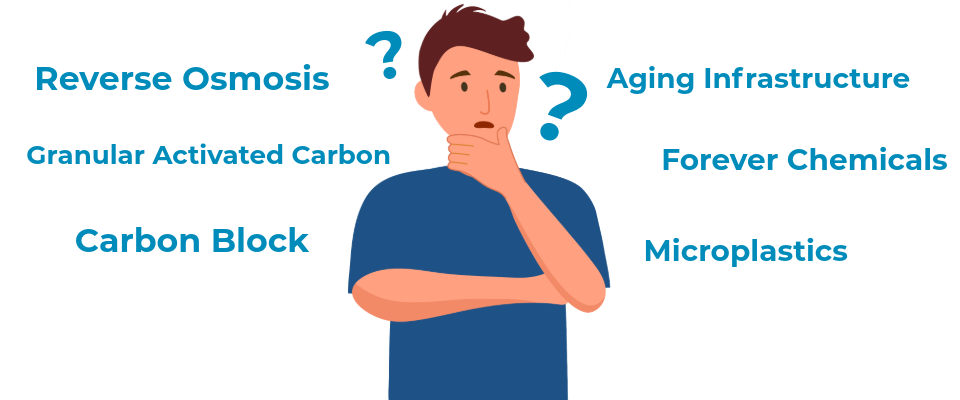
With growing awareness of aging infrastructure, chemical runoff, and emerging contaminants (Forever Chemicals and Microplastics), many people are installing drinking water filters for the first time. The challenge is that water filtration marketing can be confusing. Claims like “removes 99% of contaminants” don’t tell the full story.
Not all water filters remove the same things, and effectiveness depends on:
- The filtration technology
- The quality of the materials used
- Independent third-party certification
Understanding the differences between reverse osmosis, solid carbon block, and granular activated carbon filters makes it much easier to choose a system that actually fits your needs.
Reverse Osmosis: What It Does Well and Where It Falls Short
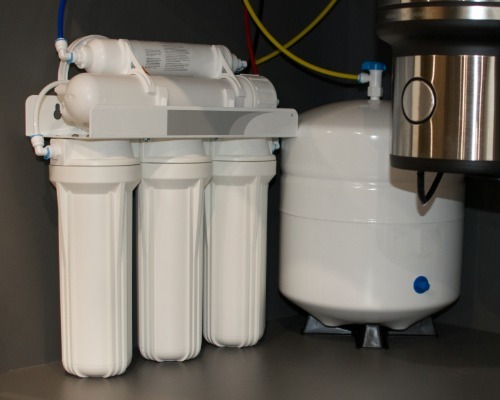 Reverse osmosis works by forcing water through a semipermeable membrane that blocks many dissolved substances. It is particularly effective at reducing:
- Total dissolved solids (TDS)
- Salts
- Fluoride
- Some heavy metals
More technical background on reverse osmosis can be found through the Water Quality Association.
Limitations of RO for Everyday Drinking Water
Despite its strengths, RO systems come with tradeoffs:
- Water waste: RO systems often discard 2–4 gallons of water for every gallon produced
- Mineral removal: Beneficial minerals like calcium, zinc and magnesium are stripped out
- Slower output: On average it takes 2-3 hours to filter water which is then held in storage tank
- Space requirements: A reverse osmosis system and its storage tank are relatively large and can occupy a significant amount of space under the sink
- Higher cost and maintenance: Multiple filters and membranes must be replaced
For households whose water is already municipally treated and regulated, RO can be more filtration than necessary.

Carbon Filtration: Two Types, Two Performance Levels
Carbon filtration is one of the most widely used water treatment methods in the world. However, not all carbon filters are created equal.
Granular Activated Carbon (GAC) Filters
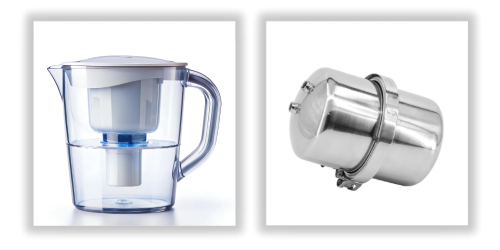
Granular activated carbon filters use loose carbon granules. Water flows quickly around the particles, which adsorb contaminants along the surface.
GAC filters are commonly found in:
- Pitcher filters
- Faucet-mounted filters
- Refrigerator filters
What they do well:
- Improve taste and odor
- Reduce chlorine
- Are affordable and easy to install
Limitations:
- Shorter contact time with carbon
- Less effective at reducing certain chemicals and heavy metals
- Granules can shift over time, reducing performance
Solid Carbon Block Filters
Solid carbon block filters are made by compressing activated carbon into a dense block. This structure forces water to pass slowly through microscopic pores, increasing contact time.
Solid carbon block filters are more effective at reducing:
- Chlorine and chloramine
- Volatile organic compounds (VOCs)
- Pesticides and herbicides
- PFAS (Forever Chemicals)
- Microplastics
- Certain heavy metals, including lead
The Environmental Protection Agency recognizes carbon filtration as an effective treatment method for many drinking water contaminants.
Why Certification Matters More Than Filter Type
This is one of the most overlooked aspects of water filtration. Not all systems remove the same contaminants. Two filters may both be labeled “carbon,” yet remove entirely different substances. The only reliable way to verify performance is through independent certification.
Understanding NSF Certification
- NSF is a third-party organization that tests water filtration systems to ensure they meet specific performance standards.
- A filter that is NSF-certified has been independently verified to reduce specific contaminants, not just generally “improve water.” Learn more directly from NSF: https://www.nsf.org/consumer-resources/water-quality/water-filters-testing-treatment
Common NSF Standards to Look For
- NSF/ANSI 42: Aesthetic effects (chlorine, taste, odor)
- NSF/ANSI 53: Health effects (lead, VOCs, cysts)
- NSF/ANSI 401: Emerging contaminants (pharmaceuticals, chemicals)
Many solid carbon block filters are certified across multiple NSF standards, while GAC filters are often certified only for chlorine and taste. Some RO systems focus on TDS reduction but may not carry certification for VOCs or emerging contaminants.
Certification tells you what a system actually removes—not what it claims to remove.
Reverse Osmosis vs. Carbon Filters: Side-by-Side
| Feature | Reverse Osmosis | Solid Carbon Block | Granular Activated Carbon |
| Improves taste & odor | ❌ | ✅ | ✅ |
| Reduces chlorine | ❌ | ✅ | ✅ |
| Reduces volatile organic compounds (VOCs) | ❌ | ✅ | Limited |
| Reduces dissolved solids | ❌ | ❌ | |
| Retains beneficial minerals | ❌ | ✅ | ✅ |
| Water waste | High | ❌ | ❌ |
| Typical NSF coverage | Limited | Broad | Narrow |
Environmental and Practical Considerations
Carbon filters, both solid block and granular, have advantages that matter in daily life:
- No water waste
- No electricity required
- Simpler installation
- Lower long-term maintenance costs
Solid carbon block filters, in particular, strike a balance between performance and sustainability.
When Reverse Osmosis May Be the Right Choice
RO systems can be appropriate if:
- You have very high TDS levels
- You have high level of nitrates in water
In these cases, RO may be part of a broader treatment strategy, but it is not automatically the best solution for everyone and work better if combined with a carbon block filter for broader filtration.
How to Choose the Right Drinking Water Filter
Before purchasing any system:
- Review your local water quality report and identify which contaminants are present
- Look for NSF certification for those specific contaminants
- Understand the difference between granular carbon and solid carbon block
- Avoid relying on marketing claims alone
Reverse osmosis, solid carbon block filters, and granular carbon filters each serve different purposes. For everyday drinking water, a well-designed, NSF-certified solid carbon block filter often delivers the best combination of safety, taste, efficiency, and value.
The goal isn’t to remove everything, it’s to remove the right contaminants, verified by independent testing.